 Retroition
Devlog 002 Who owns what? One refusal, one referral and why Retroition is going with AROS for now
In Devlog 001 I wrote that Retroition should offer officially licensed games only. That’s easy to say. In practice it means: before a particular game ends up in the app, it has to be clear who owns it today. And who owns the system it runs on in the emulator. This devlog is about how that has gone over the past few days. It isn’t legal advice, just where I stand as a developer who wants to get it right.
Who owns what?
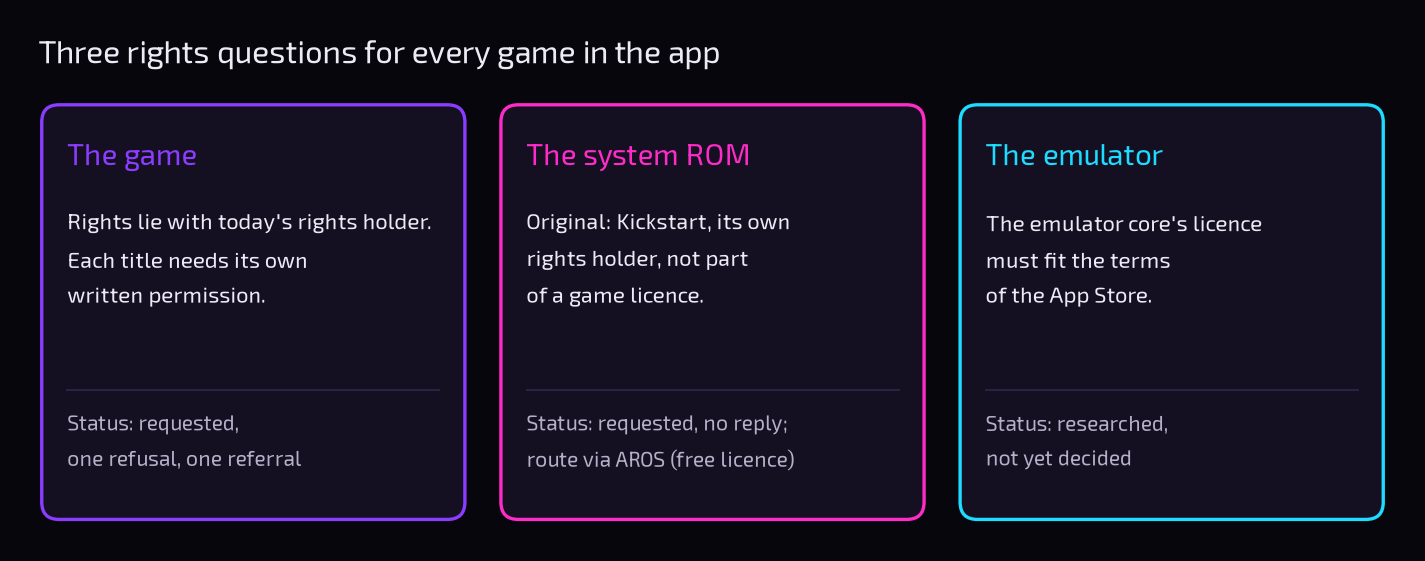
In mid-November the research bot traced the chain of rights for six games on my wish list: who originally developed and published each game, where the rights went through company sales, and whether there are official re-releases today. Every statement in that research is marked either as “documented”, with a source, or as “assessment”. I couldn’t have managed that on my own, because the trail runs through company takeovers, court records and licence texts. Whom I write to and what follows from it is my decision, and because every documented statement has a link, I can check it myself.
The result was mixed. For some titles there is a clearly identifiable, active rights holder. For others the chain is unclear or split between several parties, for example when a trademark plays a role alongside the game itself. With Ports of Call the situation is comparatively clear: according to the two authors, they got the rights back and now distribute the game themselves. Whether that also covers the graphics and music of the original version is still a separate question.
On top of that comes something that has nothing to do with the games at all: every one of these games needs an operating system ROM in the emulator, the Kickstart. It is a work in its own right with its own rights holder. In our assessment, a licence for a game does not cover it. According to the research, the rights now lie with Amiga Corporation. According to its own knowledge base, the rights holder of the Kickstart may grant sublicences for it. We found no public terms for a licence in an app. The only thing that is clear: a ROM you bought for your own emulation can’t simply be passed on. That requires a licence.
The third issue is the emulators themselves. The developer bot and the research bot gathered the licences of the emulator cores in question and checked how they fit the App Store’s terms. That hasn’t been decided yet. It is to be reviewed by a lawyer before any release.
 (enlarge image)✕ CloseOpen original image
Three rights questions that have to be settled for every game in the app, and where they currently stand. Own graphic.
The requests
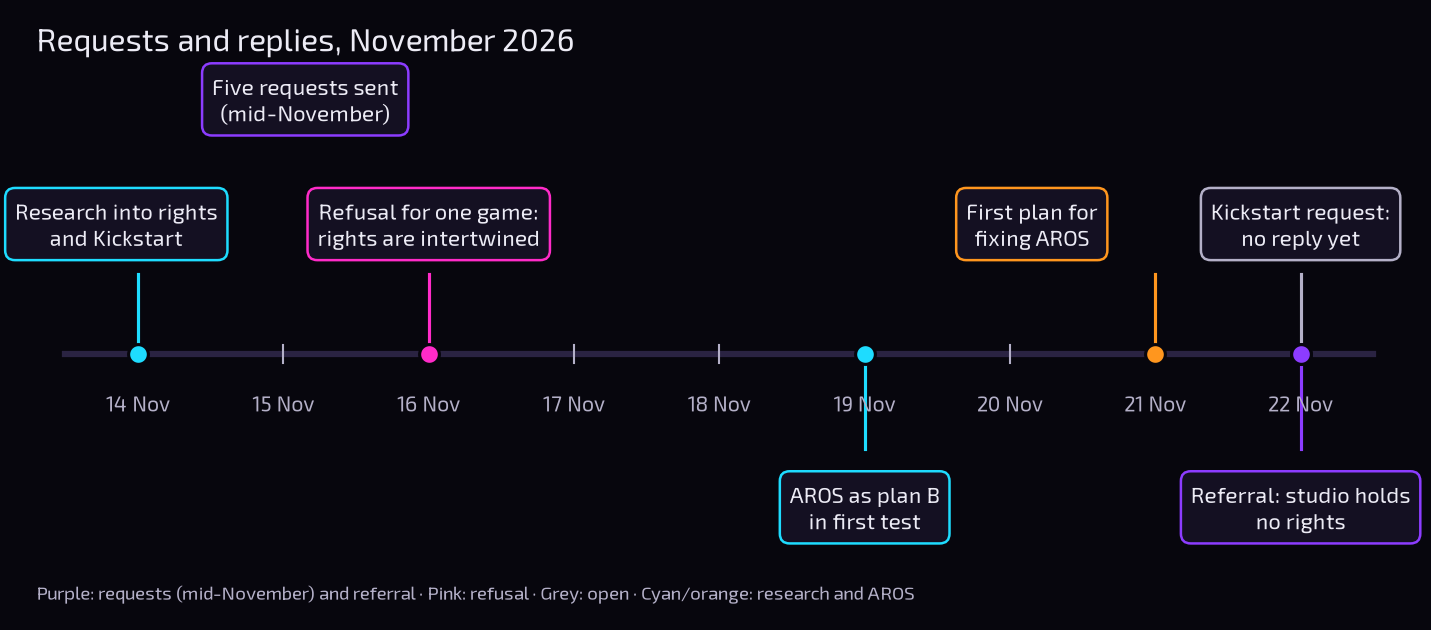
In mid-November I sent five requests: four to rights holders of games and one to the rights holder of the Kickstart. I will only name the games in public once there is a written agreement. One exception is Ports of Call, which I write about in detail in Devlog 004. One of the four game requests went to one of the two authors.
For the games the goal was the same every time, and deliberately small: written permission to use the original version in a non-public, non-commercial prototype, for demo purposes only. None of it will be published or sold. Only if the prototype is convincing would I like to talk about a proper licence with a revenue share. For two titles it was already unclear who holds the rights today. Those requests therefore start with exactly that question.
The Kickstart request had two parts. First: may I use a Kickstart 1.3 from my own licence for my private prototype, only on my Mac and my iPhone, without passing it on? Second: on what terms could Kickstart 1.3 be shipped with the app? Only together with licensed games, stored so that it can’t be copied out, never as a separate download, for a per-unit price or a revenue share.
The bots research ways to get in touch and write drafts. I send every request myself.
One refusal
On 16 November the current rights holder of one game replied. In essence: the fact that it is non-commercial makes no difference. Several interlocking rights are involved – the platform’s trademark, the former publisher and the material the game is based on. That is why there is no permission. It’s a shame, because I loved playing that game as a kid. But it is a clear answer, and I’m grateful for that.
In the refusal, the rights holder itself recommended a video that explains the licensing questions around the Amiga: After 30 years of war: the Amiga legal dispute is settled (German video; original title: “Nach 30 Jahren Krieg: Der Amiga-Rechtsstreit ist gelöst”).
On 17 November I said thank you and asked about titles with a simpler rights situation. The reply was friendly: they are currently planning a lot in the retro space, decisions will only be made next year, and they will stay in touch.
One referral
On 22 November a studio that I had taken to be the rights holder of another game replied in a friendly way: it holds no rights itself and referred me to the original developers. Chains like this are exactly what makes finding today’s rights holder so tangled.
Why all this is so tangled
One example from our research: there was a legal dispute over the rights to the Kickstart for years. It only ended in 2026 with a settlement.
Kickstart: request still open
I haven’t had a reply yet to my request to the rights holder of the Kickstart. So whether, and on what terms, the original Kickstart could go into the app remains open.
 (enlarge image)✕ CloseOpen original image
Requests and replies in November. The five requests were sent in mid-November. There is no reply yet to the Kickstart request. Own graphic.
The decision: AROS
Even so, I’ve already decided on AROS now, to reduce the risk. If the team invests time and computing power, I want to see how far we can get completely legally, without depending on someone else’s licence. The Kickstart request stays open in the meantime. So AROS isn’t a substitute out of spite, but a second route. And to be honest, I’m also curious how far a user with a few AI agents can get with a free operating system ROM. AROS is a free, open-source reimplementation of the operating system under the AROS Public License. According to our research, an AROS ROM may be shipped with an app as long as the licence terms are met. That includes making the source code of the version used available along with our own changes, enclosing the licence text and documenting the changes. I’ll still have it reviewed by a lawyer before any release. We build the ROM ourselves from the public source code instead of taking a ready-made file from another product.
The catch: AROS is a reimplementation, not a copy, and many original games don’t run on it, or don’t run properly. As plan B, AROS had already been running alongside on our side since 19 November. In the first test on my Mac, none of the three test titles got as far as the menu. Ports of Call did open its screen, but drew nothing.
That’s exactly why the team now has to adapt AROS. The games themselves stay unchanged. We look for the places where AROS behaves differently from the original and fix them there. What a ROM, the processor and the custom chips actually do, and what an emulator does along the way, I explain in the next devlog, Devlog 003. Devlog 004 is then about Ports of Call: which bugs we found in AROS and how we measure.
If you hold rights to games from that era or have questions about how we’re going about this: write to me at hello@retroition.com.
Send an email